Why this guide is different
The Kindo Vienna Guide is not a list of things to do.
It's a complete daily operating system for Vienna — built on the 2-2-1 Playbook daily structure.
Every recommendation, every route, and every contingency designed around the biology of young children — so you still have energy left at the end of the day.
Two anchor activities. Two buffer windows. One signature reset.
Every day, without exception.
Most travel guides tell you where to go. This one tells you when to stop.
When to build in silence.
When to let a morning be slow so the afternoon actually works.
What parents said about Kindo 2-2-1 structure
"Seeing the timing, buffers, and backup plans mapped out is very different from free blog advice. It feels like someone actually thought about the hard parts." — Inna G. · Parent of a 3-year-old and 7-month-oldTwo Anchors.
Two Buffers.
One Reset.
Five structural elements.
Infinite destinations.
Anchor Moments
Two intentional moments.
Not three. Not four. Two.
-
The "Yes!" Moment One high-energy, high-wonder experience — a playground, hands-on museum, zoo, or beach morning. Placed first in the day, when children are freshest.
-
The Easy Win One low-effort, sensory-gentle experience — a boat ride, aquarium, or stroller-friendly scenic loop. A soft afternoon landing that lets the day close without demanding more than your child has left to give.
Deep Buffers
The structure most
itineraries ignore.
-
Transition Buffer Slow, open-ended movement between places — a snack walk, a stroller loop, an unplanned stop. After a big morning, kids can't instantly switch into "sleep" mode. This intentional slowdown helps them regulate and move from morning excitement into a successful midday nap.
-
Rest Buffer A real reset block lasting 60–90 minutes minimum — long lunch, hotel break, quiet park. A hard constraint in every Kindo itinerary, not a preference.
Signature Reset
The non-negotiable that closes every single day.
-
The Ritual In an unfamiliar environment, everything is new — the sounds, the light, the bed. The Signature Reset is the one part of the day that doesn't change.
A sunset spot you return to each evening. A story and a local treat at the hotel. A bath and a favourite book before bedtime. The specific ritual matters less than its repetition — every night, without exception.
And Parents Matter Too
A calmer day for your child is a calmer day for you.
-
How the 2-2-1 structure protects parents too When your child becomes dysregulated, it doesn't just affect their day. It drains the capacity you need for the rest of yours — and the rest of the trip.
By building calmer days for your children — through intentional downtime and consistent evening rituals — Kindo preserves your energy, too. It gives you your holiday back.
What parents said about Kindo 2-2-1 structure
"Most family travel guides give ideas. This gives structure. I could immediately see how this would reduce decision fatigue on the trip." — Jenny S. · Parent of 2- and 4-year-oldsThe Science Behind the Structure
Why the 2-2-1 framework works by design
Sleep First
That's why our structure deliberately preserves a real Rest Buffer and a predictable closing Ritual rather than squeezing in one more attraction. ¹ Paruthi et al., 2016
Two Anchors, Not More
That's why we cap the day at two anchors — one big "YES!" and one easy win — instead of stacking multiple high-stimulation experiences. ² Berger et al., 2012
Buffers Are Not Optional
That's why Kindo builds Transition + Rest buffers to downshift before kids tip into dysregulation. ³ Gunnar et al., 2010
End the Day the Same Way
That's why we end the day the same way, even while traveling. ⁴ Mindell et al., 2015
Research & References
What's inside the Vienna Guide
Everything you need.
Nothing you don't.
The 2-2-1 Playbook is the framework.
The Kindo Vienna Guide is that framework applied — day by day, neighbourhood by neighbourhood, for children who are actually 0–5 years old in one of Europe's most rewarding — and most misnavigated — cities for families with young children.
-
Day-by-day 2-2-1 itineraries Not a list of suggestions — a structured daily plan. Each day names the morning anchor, afternoon easy win, exact buffer windows, and evening reset. Separately calibrated for 0–2 and 3–5.
-
Nap-protected scheduling Every activity is timed around sleep, not despite it. Morning anchors end before the nap window; afternoon easy wins don't start until the window closes.
-
Meltdown contingency maps Every anchor activity includes a pre-scouted recovery option within minutes. Not a frantic search while your child is screaming — a specific place already chosen for you.
-
The "What If" cards Scenario cards for the moments you can't plan, but can prepare for. Rain, fever, overtired — each card gives you a concrete next step that still feels like a holiday.
-
Emergency quick-reference Pediatric urgent care, 24-hour pharmacies, local emergency numbers, and practical essentials in one page. Fast to scan, built for the moment your brain is already overloaded.
Three pages from inside the guide.
Know exactly what you're getting before Day 1.
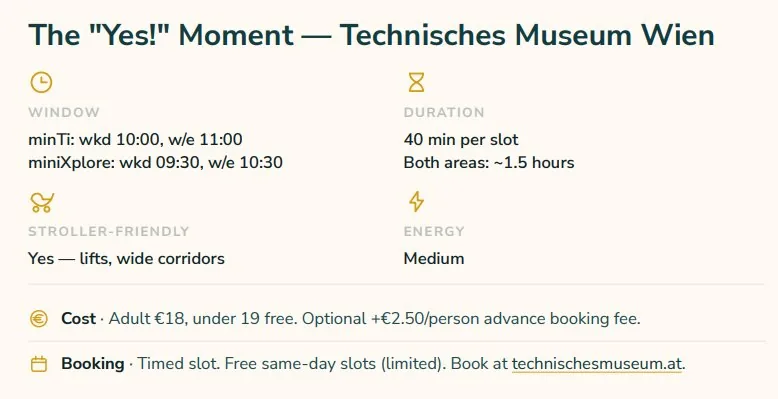
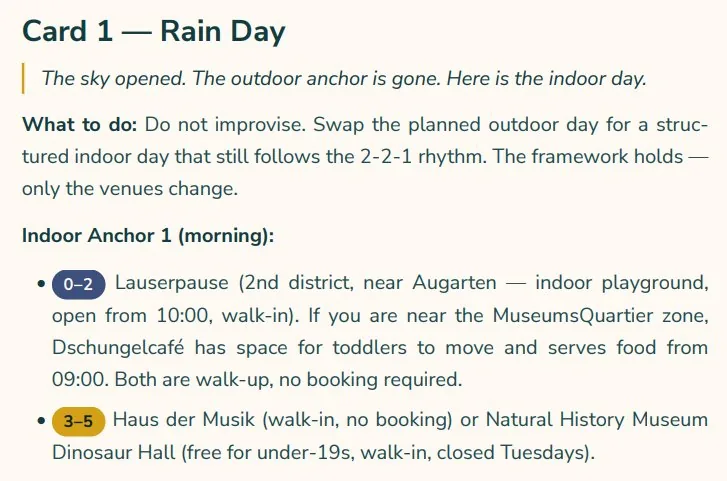
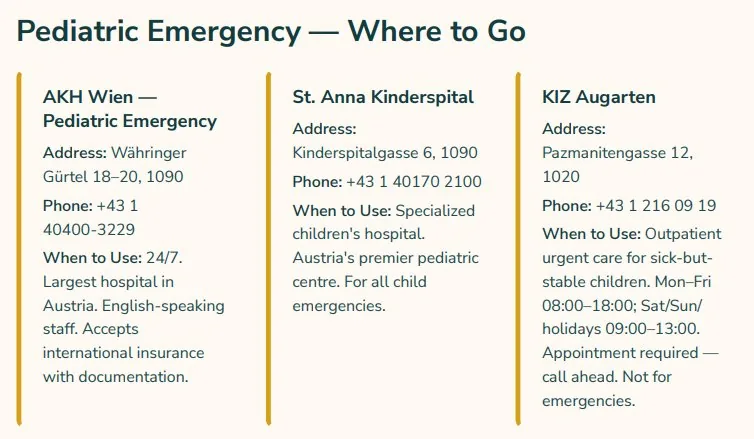
What parents said about Kindo 2-2-1 structure
"Every trip with our toddler turns into overplanning and stress, and this actually feels like a system we could follow instead of figuring everything out on the go." — Marie & Daniel F. · Parents of a 2-year-old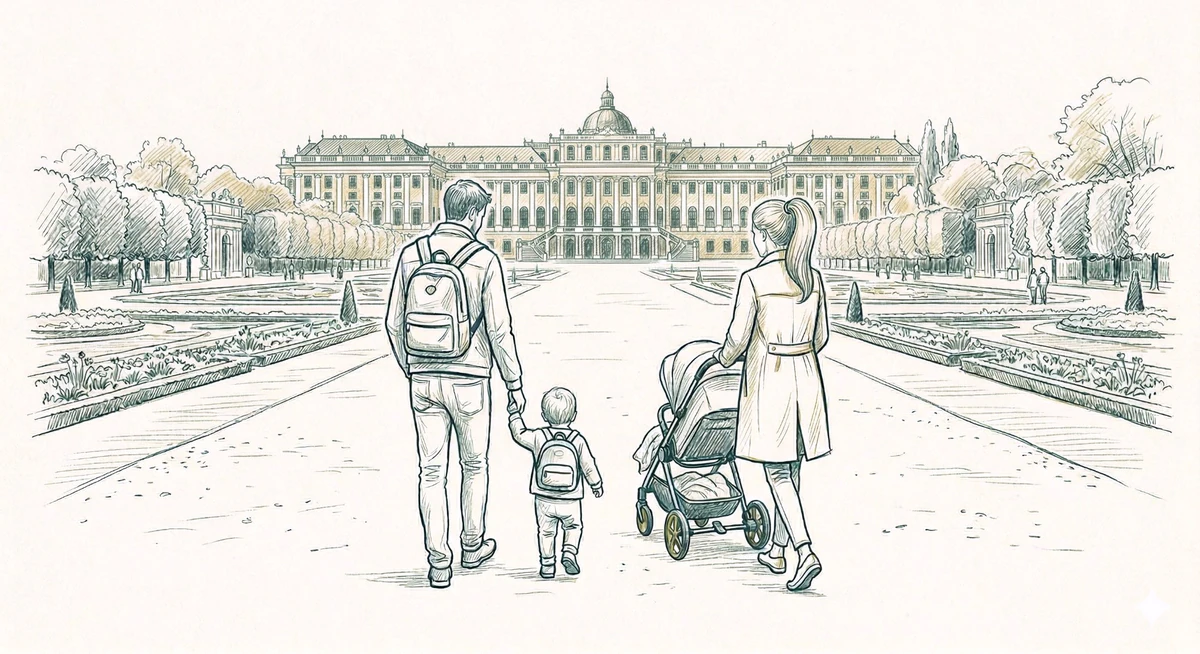
Built specifically for Vienna
Vienna wasn't built for toddlers.
Somehow, it's perfect for them.
The first thing you notice in Vienna is how easy it could be for families.
The Schönbrunn Palace Gardens stretch for over a kilometer — flat, wide, and stroller-friendly. The kind of space where a toddler can run without you constantly pulling them back.
Neighborhoods like Leopoldstadt are calm, flat, and close to everything — 10 minutes from the Prater, with enough space for a two-year-old to just be a two-year-old.
The city itself moves simply — trams 1, 2, and D circle the Ringstraße on a single ticket, and children under six ride free.
And yet — this is where most trips quietly start to fall apart.
Because Vienna rewards parents who know how to pace it. And it punishes the ones who try to fit the Ringstraße, Schönbrunn, and the Naschmarkt into a single day, with a tired toddler already past their limit.
Most families only realize this on Day 3. This guide is built so you understand it before Day 1.
Common questions
The things skeptical parents ask before they buy.
And the math is simple: you're protecting a €3,000–5,000 family trip for the cost of two museum tickets.

Why this guide exists
The trip that started this.
In 2024, we took our one-year-old to Lyon.
We had done the research. We had a list. What we did not have was a plan that accounted for the reality of travelling with a baby.
The scheduling was wrong. The activities weren't built for that age. When things went sideways — and they did, repeatedly — we had no backup. We were finding solutions in the moment: where to buy food she would actually eat, which brands were safe, how to get somewhere quickly with a pushchair and a baby who had stopped cooperating twenty minutes ago.
It was not a disaster. But it was close. And it cost us more energy than the trip was worth.
The following winter, we took both kids to Vienna. Two under three, this time with a plan I built before we left. I had spent ten years in the travel industry building itineraries, managing logistics, solving problems before they became emergencies. This time I applied that to my own family, with the children's needs at the centre of every decision.
That structure is what makes the days work. And when the days work, when the pacing is right and the children are not past their limit, there is space left for something else.
For the two of you.
Every Kindo guide includes a verified babysitter agency list and two or three tested evening options, depending on how long you want or can manage to be out, so you can actually enjoy the city you travelled so far to see.
Vienna was our proof of concept. It worked.
Zero risk
The 14-Day Kindo Guarantee.
Simple. Honest. No hoops.
We believe the right structure genuinely changes how travel with young children works.
Try the full 2-2-1 Playbook on your Vienna trip. If it doesn't make your family travel feel calmer, more structured, and more in control — email us within 14 days for a full refund.
No questions beyond "how can we help?"
Kindo · Vienna Family Guide
Vienna is waiting.
The thinking is done.
One structure that holds the day together — from the first Prater loop to the last bedtime story in your apartment.
5 days. 100+ pages. Calibrated for ages 0–2 and 3–5. Built for the trip that has to work.
A €3,000–5,000 family trip. Protected for the price of two museum tickets.